Research Intern, AI4S / AI4AI
ModelBest · Internship
Research intern in the Intelligent Evolution Lab, focusing on AI for Science and AI for AI.
Mathematics & machine learning
Ph.D. Student in Mathematics
The Chinese University of Hong Kong
Hi, I'm Ziyang. My research interests are AI for Science, AI for AI, and LLMs.
At CUHK since August 2024, advised by Prof. Tieyong Zeng and Prof. Liu Liu.
Selected work
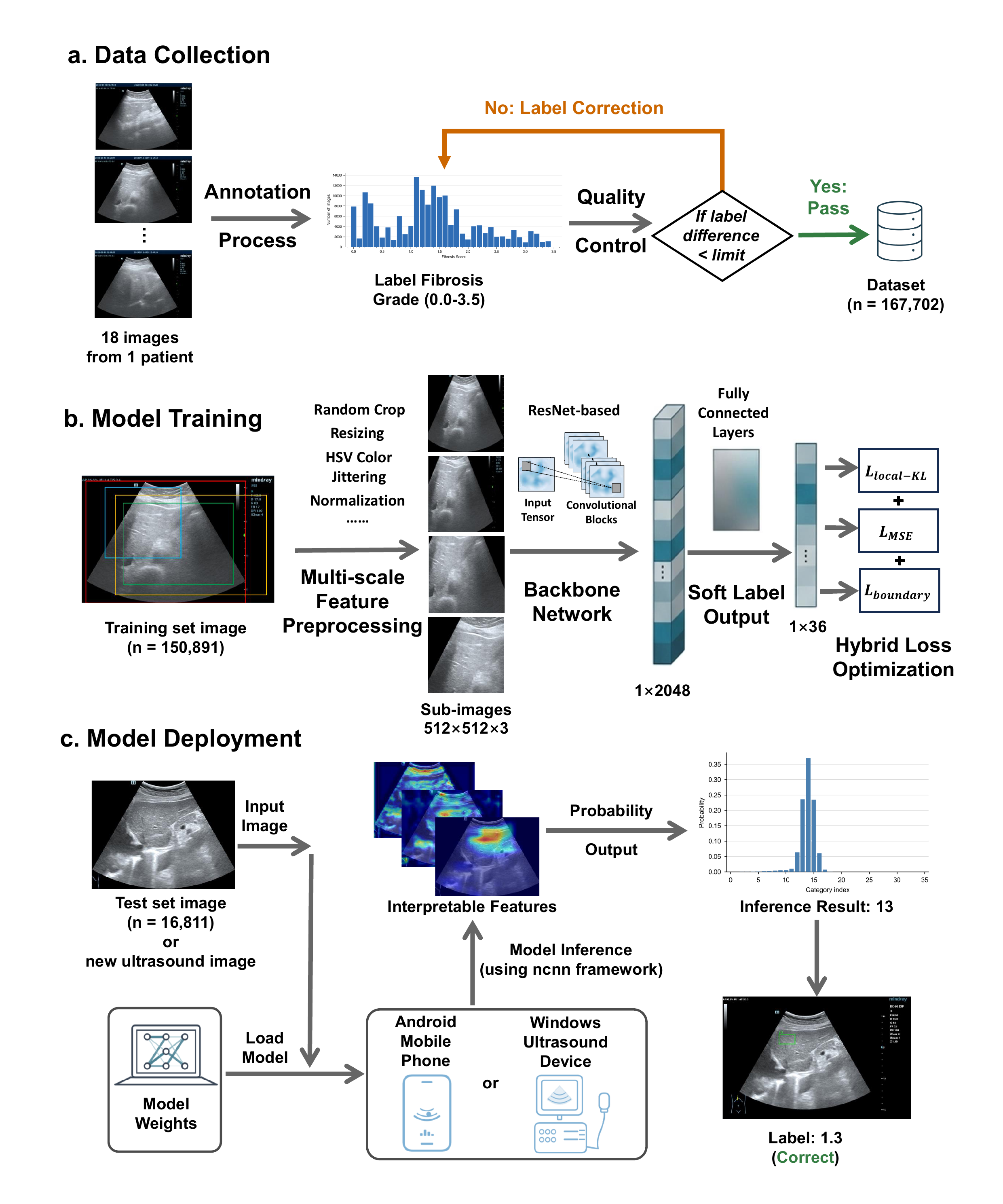
SFibAI grades liver fibrosis from ultrasound, trained on 167,702 images across 36 stages. The framework includes a Windows/Android SDK.
Liver fibrosis caused by schistosomiasis is a major health problem in endemic regions. Ultrasonography is widely used for screening, but grading remains subjective and dependent on specialist expertise. Here we show that a deep learning system can provide automated, fine-grained assessment of liver fibrosis caused by Schistosoma japonicum. We developed and evaluated the system using a multicentre dataset of 167,702 ultrasound images labelled on a 36-level scale from 0.0 to 3.5, designed to capture gradual disease progression and map onto four clinical grades. Of these images, 16,811 were reserved for the independent test set. In this test set, 93.9% of predictions were within 0.5 grades of expert labels, with a mean absolute error of 0.116. We further developed a deployable version that ran on Windows and Android devices, processing each image in less than 400 milliseconds. These results support scalable and more consistent ultrasound screening and follow-up in endemic regions.
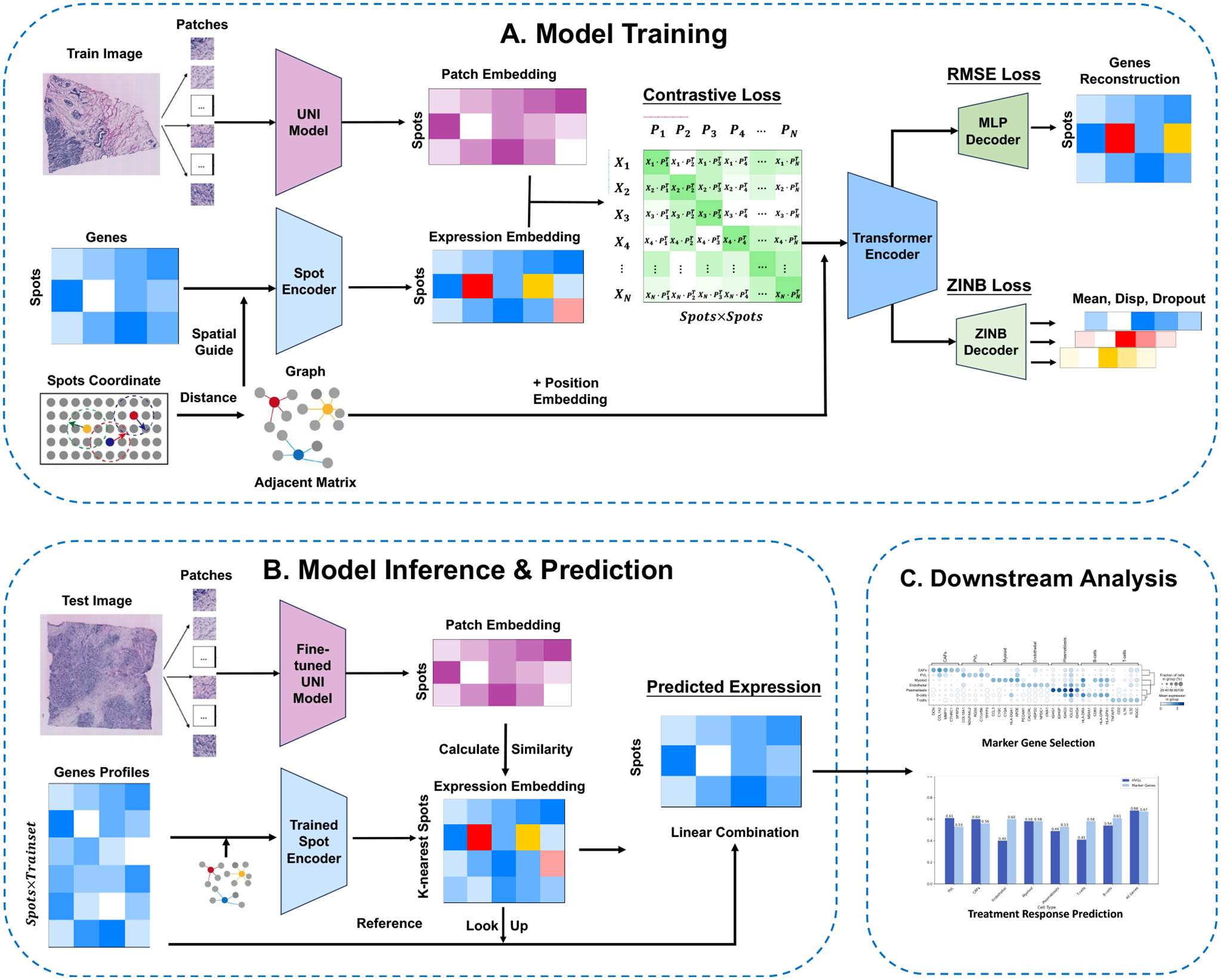
Foundation-model features and spatially guided contrastive learning predict spatial transcriptomic profiles from histology images.
Spatial transcriptomics (ST) enhances single-cell RNA sequencing by revealing transcript distribution, offering critical insights into heterogeneous diseases such as breast cancer. However, the high cost and lengthy processes of generating high-quality ST data limit clinical application. Recent deep learning methods predict ST from histology images, but often fail to capture both morphological features and spatial context. We introduce FOCST, a foundation model-driven framework for ST imputation that leverages spatial guided contrastive learning. FOCST begins with UNI, a large histopathology foundation model, to extract visual features from tissue images. These are integrated with expression data in a unified embedding space via contrastive learning, enabling cross-modal prediction and imputation. To further enhance spatial awareness, a graph neural network incorporates positional information, improving regional detection and interpretability.Benchmarking demonstrates FOCST’s superior performance over state-of-the-art methods and alternative vision encoders (paired Wilcoxon signed-rank tests, FDR-adjusted p < 0.05, N = 6 images). Predicted profiles enable clinically relevant downstream analyses, including patient stratification by treatment response (ROC AUC (Receiver Operating Characteristic – Area Under the Curve) = 0.79). Our results highlight the promise of combining foundation models and spatially guided learning to efficiently generate ST insights, advancing cancer research and precision medicine.
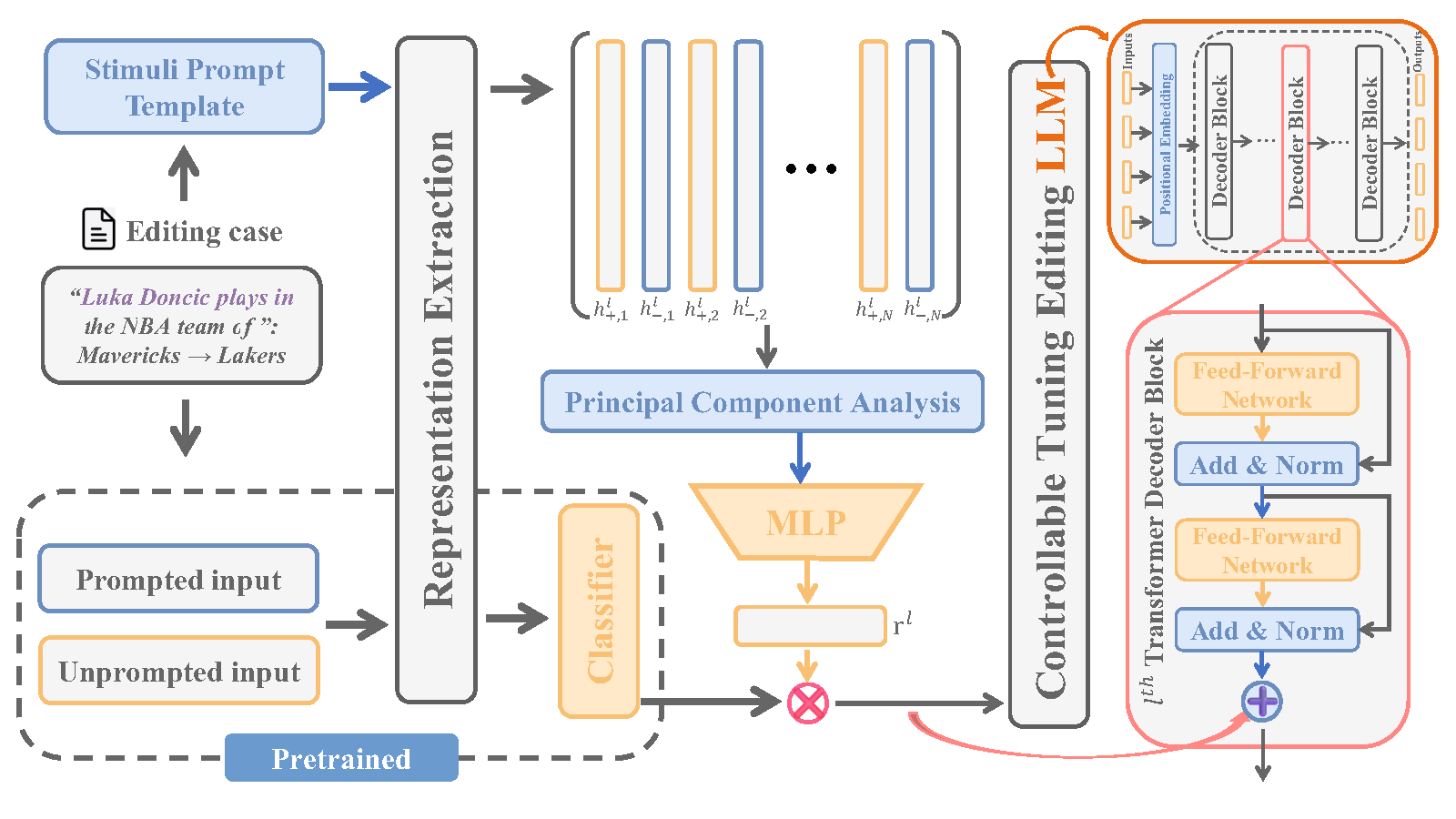
A two-stage framework for controllable LLM knowledge editing that reduces overfitting while preserving reliability, locality, and generality.
Large language model editing methods frequently suffer from overfitting, wherein factual updates can propagate beyond their intended scope, overemphasizing the edited target even when it’s contextually inappropriate. To address this challenge, we introduce REACT (Representation Extraction And Controllable Tuning), a unified two-phase framework designed for precise and controllable knowledge editing. In the initial phase, we utilize tailored stimuli to extract latent factual representations and apply Principal Component Analysis with a simple learnbale linear transformation to compute a directional “belief shift” vector for each instance. In the second phase, we apply controllable perturbations to hidden states using the obtained vector with a magnitude scalar, gated by a pre-trained classifier that permits edits only when contextually necessary. Relevant experiments on EVOKE benchmarks demonstrate that REACT significantly reduces overfitting across nearly all evaluation metrics, and experiments on COUNTERFACT and MQuAKE shows that our method preserves balanced basic editing performance (reliability, locality, and generality) under diverse editing scenarios.
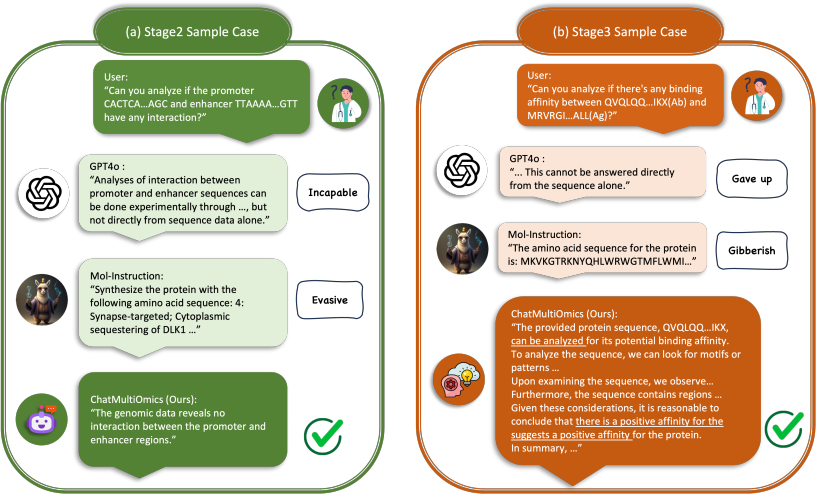
An instruction-tuning dataset and benchmark for DNA, RNA, proteins, and multi-molecule sequences, with ChatMultiOmics as a three-stage training baseline.
Large language models (LLMs) have shown remarkable capabilities in general domains, but their application to multi-omics biology remains underexplored. To address this gap, we introduce Biology-Instructions, the first large-scale instruction-tuning dataset for multi-omics biological sequences, including DNA, RNA, proteins, and multi-molecules. This dataset bridges LLMs and complex biological sequence-related tasks, enhancing their versatility and reasoning while maintaining conversational fluency. We also highlight significant limitations of current state-of-the-art LLMs on multi-omics tasks without specialized training. To overcome this, we propose ChatMultiOmics, a strong baseline with a novel three-stage training pipeline, demonstrating superior biological understanding through Biology-Instructions. Both resources are publicly available, paving the way for better integration of LLMs in multi-omics analysis. The Biology-Instructions is publicly available at: https://github.com/hhnqqq/Biology-Instructions.
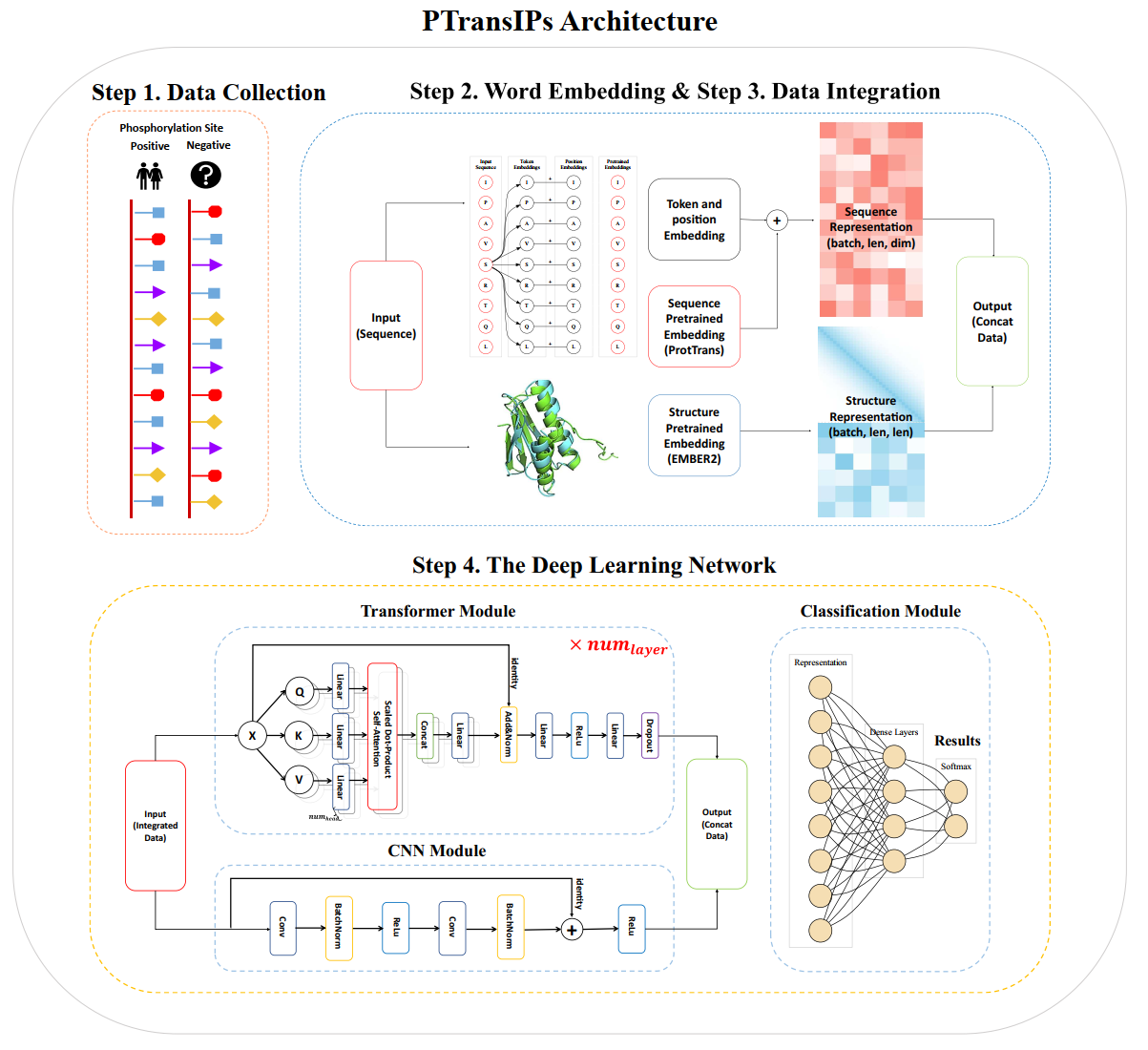
Protein language model embeddings and a transformer for phosphorylation-site prediction, with transductive information maximization for peptide bioactivity tasks.
Phosphorylation is pivotal in numerous fundamental cellular processes and plays a significant role in the onset and progression of various diseases. The accurate identification of these phosphorylation sites is crucial for unraveling the molecular mechanisms within cells and during viral infections, potentially leading to the discovery of novel therapeutic targets. In this study, we develop PTransIPs, a new deep learning framework for the identification of phosphorylation sites. Independent testing results demonstrate that PTransIPs outperforms existing state-of-the-art (SOTA) methods, achieving AUCs of 0.9232 and 0.9660 for the identification of phosphorylated S/T and Y sites, respectively. PTransIPs contributes from three aspects. 1) PTransIPs is the first to apply protein pre-trained language model (PLM) embeddings to this task. It utilizes ProtTrans and EMBER2 to extract sequence and structure embeddings, respectively, as additional inputs into the model, effectively addressing issues of dataset size and overfitting, thus enhancing model performance; 2) PTransIPs is based on Transformer architecture, optimized through the integration of convolutional neural networks and TIM loss function, providing practical insights for model design and training; 3) The encoding of amino acids in PTransIPs enables it to serve as a universal framework for other peptide bioactivity tasks, with its excellent performance shown in extended experiments of this paper. Our code, data and models are publicly available at https://github.com/StatXzy7/PTransIPs.
Tools & practice Agent evaluation · Tool use · PyTorch · Transformers · Multimodal learning
SFibAI published online in Nature Communications.
REACT accepted to EMNLP 2025.
PTransIPs accepted to IEEE J-BHI, with Haitian Zhong and Tianchi Lu (卢天驰).
Awarded my second National Scholarship (2021–2022).
Awarded my first National Scholarship (2020–2021) during undergraduate study at Lanzhou University.
Oct 2026 — Present
ModelBest · Internship
Research intern in the Intelligent Evolution Lab, focusing on AI for Science and AI for AI.
Oct 2024 — Oct 2025
Mathematical-Model-Based Image Algorithm Research, with Prof. Tieyong Zeng.
Developed an image restoration pipeline for information-missing artifacts caused by short-exposure sampling of screen refresh cycles in mobile photography, combining Sa2VA-8B language-guided screen/person segmentation, luminance-jump maps for banding-region detection, structure-aware mask refinement, and long-short exposure frame registration and fusion.
Jul — Aug 2024
AI for Mathematics Formalization and Theorem Proving Seminar.
Jan — Oct 2023
Western University · Internship
Schulich School of Medicine & Dentistry · London, Canada
Deep Learning for Integrating Multimodal Data for Precision Medicine, supervised by Prof. Pingzhao Hu.
Aug 2024 — Jul 2028Expected
Ph.D. in Mathematics · Hong Kong
Supervisors: Prof. Tieyong Zeng and Prof. Liu Liu.
Sep 2020 — Jun 2024
B.S. in Statistics · Lanzhou, China
GPA: 92.69/100 · Rank: 1/52
Supervisors: Prof. Zhouping Li and Prof. XingXing Jia.
Sep 2017 — Jul 2020
Nanjing, China
Teaching Assistant at The Chinese University of Hong Kong.
Brilliant Graduate of Lanzhou University — Academic Type (出彩毕业生·学术深造型), top 5 from university. News ↗
CUHK Vice-Chancellor's PhD Scholarship.
Outstanding Graduate of Gansu Province (甘肃省优秀毕业生). News ↗
Chun-Tsung Scholar (䇹政学者), 25th annual program. Certificate ↗ News ↗
Mitacs Globalink Research Intern Scholarship. Certificate ↗ News ↗
National Scholarship (国家奖学金), rank 1/117. Certificate ↗ News ↗
Merit Student of Gansu Province (甘肃省三好学生), 0.6%. Certificate ↗ News ↗
National Scholarship (国家奖学金), rank 1/157. Certificate ↗ News ↗